
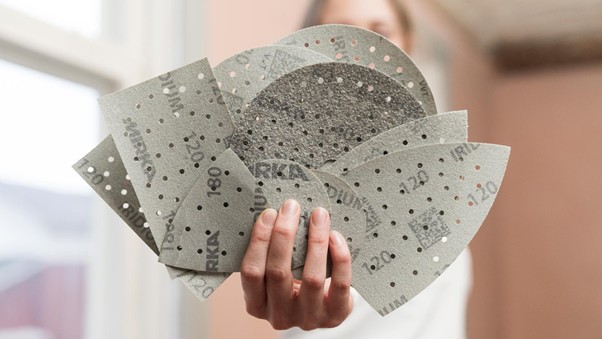
Choosing the right sandpaper depends on what material you’re sanding and what result you want. Here’s a clear guide to help you pick the correct type and grit every time.
Choosing the Right Grit
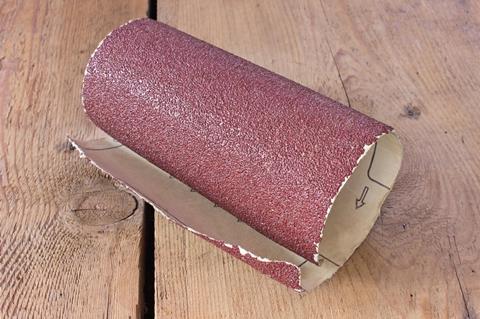
Sandpaper grit determines how coarse or fine it is.
Sandpaper works by scratching away defects with thousands of tiny abrasive particles.
The most common sanding system numbering is known as CAMI. With this system, the lower the number, the coarser the sandpaper grit; and the higher the number, the finer the sandpaper grit.
- Extra Coarse Grit (12-36) – Used for very rough work, heavy machines, wood floors, etc.
- Coarse Grit (40–60) – Removes material quickly. Good for stripping paint, shaping wood, removing rust. Leaves deep scratches A good choice for rough sanding and removing stock quickly, such as sanding the edge of a sticking door with a belt sander.
- Medium Grit (80–120) – Most common “general use” range. Smooths surfaces without removing too much. Makes a good starting point for most projects, from sanding unfinished wood to removing old varnish.
- Fine Grit (150–180) – Pre-finishing stage. Great for removing the scratches left by coarser grits on unfinished wood and for lightly sanding between coats of paint.
- Very Fine Grit (220–400) – Ultra-smooth finish. For finish sanding or sanding between finish coats. Used for light sanding between coats of finish and to sand metal and other hard surfaces.
- Extra Fine (600–3000+) – Polishing level. Ideal for automotive paint, resin, metal polishing
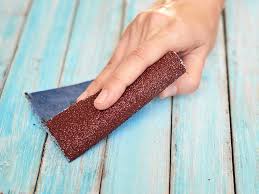
Pick the Right Abrasive Material. Different sandpapers use different abrasive particles:
Garnet: Best used for hand sanding. Suitable for sanding bare wood. Dulls quickly.
Emery: Excellent for hand or power sanding metal. Can also be used to polish metal. You can often find Emery sandpaper on flexible cloth backing.
Ceramic: Used primarily on belts and discs for power sanding. Used for aggressive material removal on wood.
Silicon carbide: One of the best types but wears fairly quickly. Has many uses, including wood, plastic and metal. Can be used for wet sanding.
Aluminum oxide: Common sandpaper. Great for power or hand sanding on wood, paint, drywall or metal. Lasts longer than most.
Zirconia alumina: Suitable for wood, fiberglass, metal and painted surfaces. Typically used with belts, pads and discs for power sanding. Lasts decently long.
Tips and Tricks
- If it looks bad-it probably is. This same principle applies to your hands. Run your hands over what you are sanding. It is amazing what you can feel that you cannot necessarily see. Working with wood is about as much feel as it is sight.
- Sanding with the grain of the wood is generally preferable to sanding against it. You can definitely take more off if you are sanding with power tools by going cross-grain-but if you are hand sanding, with the grain is the way to go.
- For really odd-shaped edges, make some sanding sticks. Choose differently shaped dowels and attach sandpaper to them with staples or double-sided tape.
- The golden rule of sanding is to start with a grit coarse enough to quickly remove surface imperfections and follow with incrementally finer grits. Each successive grit erases the scratches of the coarser one before, until the scratches themselves become undetectable to the eye and the touch.
- Sponge-backed sandpapers are helpful when working with pieces that have round or uneven edges.
- After sanding your woodworking project, you need to remove all traces of sawdust before you’re able to apply the paint or stain finish of your choice.